What's actually happening to PIP in 2026

Hi, it's Paul here (not Sha, she does the Wednesday Wrap Up). I'm here because I spent some time this week checking what's actually true from some of the talk about PIP payments, and to spot the myths and rumours that pop up online.
Lately, Sha's social media feeds have been full of worried posts. Some people are afraid they'll lose their PIP in November. Others have heard stories about supermarket vouchers, or that the DWP is secretly reading Facebook posts to catch them out.
So I went digging to see where all this was coming from. I thought I'd find viral Facebook posts and a handful of loud accounts on X.
But that wasn't it. The most convincing bit of PIP misinformation out there right now isn't on social media at all. It's on sites that look just like news websites.
The short version
Your PIP award is safe. There have been no cuts, and the eligibility rules have not changed. None of the changes in the 2025 welfare bill apply to you, because the parts about PIP were removed before it became law.
There's nothing scheduled for November 2026. That date comes from a policy that was scrapped more than a year ago.
There are two real changes this year. Both are about how the system works, not about money, and most people will find them helpful.
The Timms Review reports in the autumn. Possibly later. When it does, it will make recommendations, and recommendations are not law. Anything arising from it would need fresh legislation after that.
Right. Now the detail.
The four-point rule that doesn't exist
Here's the claim, and you may well have seen it: from November 2026, you'll need to score at least four points in a single daily living activity to qualify for the daily living component. Around 370,000 people lose out. Sometimes the figure quoted is 1.2 million.
It has dates. It has numbers. It reads as if it came from a government press release.
That rule is gone. It was a real proposal in the Universal Credit and Personal Independence Payment Bill in 2025, but it was removed from the Bill on 1 July 2025 after a lot of pushback. The law that actually passed, the Universal Credit Act 2025, didn't change PIP at all. The November 2026 date was when the rule would have started, but now it's just a ghost story.
Parkinson's UK on the withdrawal of the four-point rule
What's surprising is how this rumour keeps going. It isn't mainly spreading on Facebook. Instead, it's popping up in news articles published before the U-turn, which were never updated. These articles still show up high in Google searches for "PIP changes 2026". AOL and Yahoo News UK are big sources of this old information.
So the usual advice to be careful about social media is not much help here. Someone looking for reassurance, doing the right thing, ends up on a site that looks official and gets told they're about to lose their money in four months.
No one's doing this on purpose. It's just old news that never got updated. But if you're reading it at 2am, it feels just as real as the latest announcement.
The vouchers
Second most common one. PIP is being replaced with vouchers, or a pre-paid card, or one-off grants.
This one deserves a bit of care, because if someone tells you they remember a plan to put PIP on pre-paid cards, they are not making it up. That was a real, published proposal. It got a lot of coverage, entirely legitimately, at the time.
But that plan was dropped. Ministers confirmed the change, and PIP is still paid as cash into your bank account. You decide how to spend it.
Benefits and Work: the PIP vouchers proposal is dead
So the mistake here isn't falling for something made up. It's just being a bit behind on the updates. Worth keeping in mind before telling someone they've been tricked, because they haven't, not really.
What has actually changed
Award lengths have been extended. Regulations came into force on 2 June 2026. New claims from people aged 25 and over now get a minimum three-year period before the first review, where previously that gap could be as short as nine months. Get through that first review still qualifying, and the next award can run for up to five years.
The DWP can now make existing awards last longer, without you asking and without another assessment. The bit that matters, and often gets missed: this only works one way. They can make your award longer, not shorter, and it doesn't change how much you get.
Benefits and Work on the DWP extending existing awards
The regulations themselves, GOV.UK
I was going to leave that as theory. Then, while I was part way through writing this, the post arrived and Sha opened a letter from the DWP extending her award to March 2029. Almost three more years, no review, no form, no assessment, nothing asked of her at all.
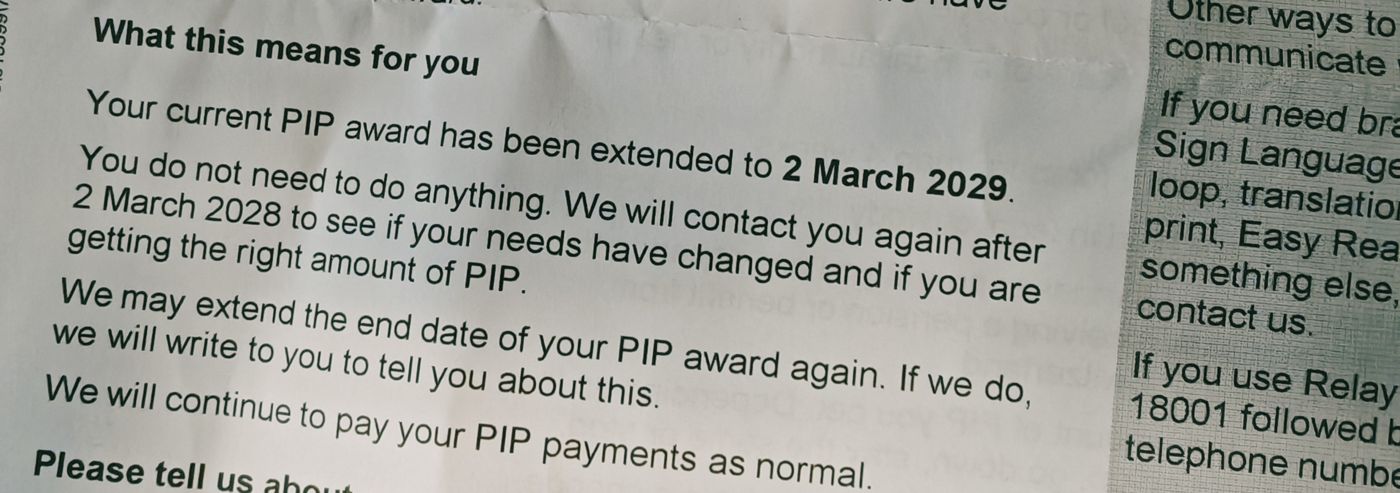
I'll be honest about the ten seconds before she opened it, because I suspect you know them. Both of us clocked the envelope, both of us assumed the worst, and neither of us said so out loud. That is what years of this system does to people. The letter was good news and we still braced for it.
So if one turns up telling you your award now runs longer than you expected, that really is all it means. Nothing else is coming. I can't promise you'll get one, and I've no idea how they're choosing who does, but if you do, it isn't the start of something.
Benefits and Work on the DWP extending existing awards
The regulations themselves, GOV.UK
There will be more face-to-face assessments again, after years when most were done by phone. Telephone and video assessments are still available, and you can ask for one if travelling to an assessment centre is hard for you.
I know this isn't good news for everyone. If you're housebound or travel is exhausting, being told you can ask for an alternative only helps if you have the energy to do it. But it's still less worrying than the rumour that everyone is being called in for in-person assessments, which simply isn't true.
Things that are true and still worth knowing
Not everything frightening is false. These are all real, and I'd rather you heard them here with the context attached than somewhere else without it.
DLA to PIP reassessment is restarting. Around 3,000 adults still on DLA will be invited to claim PIP from September 2026. This will expand later. If you get an invitation and respond within the window you're given, your DLA carries on until at least 28 days after the PIP decision. There is no gap in payment for people who reply on time.
Motability has changed. Tax exemptions for the scheme changed on 1 July 2026, and Motability is removing luxury vehicles from what's on offer. Real, confirmed, and entirely separate from PIP eligibility, though I understand perfectly well why it doesn't feel separate if you're a Motability customer.
The Blue Badge link is under review. The automatic connection between PIP mobility scores and Blue Badge eligibility is being looked at, with a conclusion expected around the autumn. Nothing has been decided, and existing entitlements are protected under current rules. But "under review" is accurate, and watching it closely is reasonable.
The Timms Review really did say PIP is no longer fit for purpose. That's not spin or a campaigner's paraphrase. It's the actual finding, from the interim report published on 9 July, drawing on more than 38,000 responses, over 90% of which described negative experiences. If you find that unsettling, you're reading it correctly.
The Timms Review interim report, GOV.UK, 9 July 2026
The MS Society's summary of what it found
The Commons debate on the report, Hansard
One thing to keep in mind: the interim report doesn't make any recommendations. It's just an update. The real suggestions come in the final report, and only then does anything start to happen. Realistically, nothing will change before 2027.
On being watched
Two claims that get tangled together, and both need splitting apart.
NHS records. When you claim PIP, you're asked to consent to your GP or other health professionals sharing relevant information with the DWP. That is genuine, it's disclosed, and it's consent-based. It is not the DWP quietly hoovering up your medical history behind your back. It's worth knowing that declining consent can weaken your claim if the DWP then hasn't got enough evidence, which is an uncomfortable sort of choice, but it isn't surveillance.
NHS England guidance on information sharing with the DWP
Social media. DWP fraud investigators can look at public social media, and sometimes do. This is targeted at specific fraud investigations. It is not blanket monitoring of four million claimants; it isn't new, and it isn't automated.
I'd add that this is worth pushing back against, even though there's some truth in it, because the fear itself does harm. People stop sharing photos of the one good day they had, just in case it gets used against them. That's a real cost, paid by people who have done nothing wrong.
Where to look instead
The problem with "check your sources" as advice is that it assumes you know which ones are any good. So here's a short list. If a claim about PIP doesn't appear on at least one of these, treat it as unconfirmed.
- GOV.UK for the actual policy, and legislation.gov.uk if you want to see whether something is genuinely law
- Benefits and Work for changes explained properly and early
- Citizens Advice and Turn2us for what to do about your own situation
- Scope, and the condition-specific charities such as the MS Society and the National Autistic Society, all of whom put out clear explainers and are quick to correct nonsense
- The House of Commons Library briefing on benefit changes for disabled people, which is neutral, dated, and says exactly which law it's describing
If an article about benefits has no date, or doesn't say which law it's talking about, just close it.
A note on what I couldn't check
For clarity. I don't use X/Twitter, and I'm not in the private Facebook groups or WhatsApp chats where I'd guess a fair bit of this is actually circulating. So this is what's out in the open. There'll be more that isn't.
If something is going round your groups that I haven't covered here, tell us. Sha or I will go and check it, and if it turns out to be real we'll say so.
That's the point. We're not here to tell you everything is fine. We're here to tell you what's really happening, so you can focus your energy on the things that matter, not on old rumours from 2025 that never got taken down.
KOKO